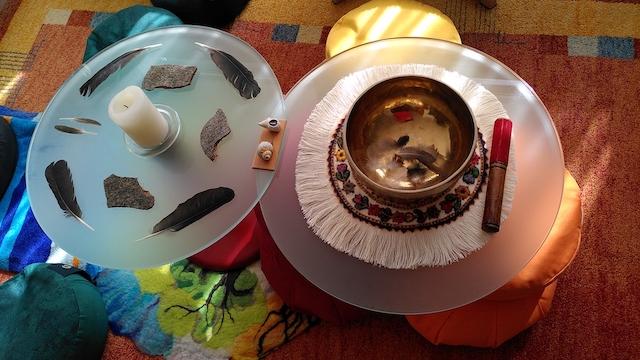
We host Council sessions to support our inquiry, deepen our practice, and weave community. Rooted in ancient traditions of storytelling, we bring this practice into the context of our modern lives as human-researcher-practitioners.
A “Council” is an intentional space that we cultivate together, based on mindful presence, shared storytelling, deep listening, witnessing, and confidentiality. While we usually invite stories centered on a given theme, sometimes new and unexpected directions can emerge.
We are looking forward to being with you in Council!
Form and Structure
The basic form of a Council is a circle – virtual or in person – where all participants sit at equal distance and eye level around a center. Facilitators are part of the circle while holding additional responsibility for the session structure and flow. This setup and the agreement of confidentiality can support the group for a “deep dive” together.
A talking piece is passed around the circle, indicating whose turn it is to speak while all others are listening. In an online setting, this can be supported by muting and unmuting the microphone.
The speaking order can strictly follow the shape of the circle, or it can be more dynamic to weave voices in a Web. There are also special forms and variations of Council, such as a Fishbowl or Spiral setting.
Intentions
A Council is supported by the following intentions (or guidelines):
- Speak from the heart
- Listen from the heart
- Be lean of expression
- Be spontaneous
- Honor confidentiality(*)
- Speak what serves you, the circle, and the larger whole
(*) This intention is sometimes described as a “rule”. The shared commitment to neither re-tell nor comment on someone else’s story (both during and after a session) supports an atmosphere of trust that can allow for deeper sharing during Council.
Flow
You can imagine the flow of a Council as follows:
- We remember the intentions of Council, e.g. by speaking them aloud.
- We do a grounding practice (breathing, silence, movement).
- We open the ceremony by inviting everyone to bring dedications, qualities, intentions to (in)form the “center” of the circle.
- We offer a prompt for everyone to check in.
- We offer a prompt for everyone to share stories.
- We invite witnessing of what was shared and received.
- We close the ceremony, e.g. with a gesture of movement or sound.
Preparing
We recommend that you take these preparations for our online time together in Council:
- Slow down. See if you can reduce the pace of your activities already before the session begins. Even just a few minutes can help.
- Arrive early. In our online Council gatherings, we “open doors” for your arrival within +/-5 minutes around the starting time, to create a safe container that can hold the energy of the circle.
- Minimize distractions. See that you can have a private space, stay in one place, and be undisturbed during our online time together. This also supports the whole group.
- Bring your talking piece. Optionally, you can choose a personal item that you can hold whenever it is your turn to speak.
Resources
Website: Ways of Council
Website: We Are Open Circle
Website: The Circle Way
Book: Jack Zimmermann and Virginia Coyle (2009). The Way of Council (2nd Edition). Bramble Books.
Book: Ann Linnea and Christina Baldwin (2010). The Circle Way – A Leader in Every Chair. Berrett-Koehler Publishers.
Book: Heather Plett (2020). The Art of Holding Space – A Practice of Love, Liberation, and Leadership. Page Two.
Book: David Bohm (2004). On Dialogue (2nd Edition). Routledge.
Video: The Power of Listening – An Ancient Practice for Our Future. Leon Berg at TEDxRedondoBeach (2013).